Ecolink, Inc.
Q
  1. Home
  2. MACT Standards
  3. Does your Vapor Degreaser meet MACT Standards?

Does your Vapor Degreaser meet MACT Standards?

Last updated:

Recently, the United States Environmental Protection Agency (EPA) inspected vapor degreasers at several plants, in a variety of industries, and unfortunately, every plant involved in the inspection did not comply with the EPA’s Vapor Degreaser Maximum Available Control Technology (MACT) Standard. The average penalty cost levied on each plant found not to be compliant was over then thousand dollars, which, because the penalties are not tax deductible, had to be paid out of the profits of each company. Additional costs were involved as well, such as management time, fees for both attorneys and consultants, along with wasted solvents. The following were reasons for non-compliance found during the inspections:
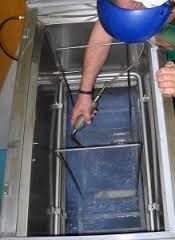
  • Ecolink1 The chain hoist used to lower and raise a parts container into the vapor degreaser exceeded the maximum allowable speed of eleven feet per minute. The reason for the specified maximum speed is to assure the vapor blanket is not disrupted to the extent that vapor spills out of the degreaser and emanates into the air.
  • The temperature at the center of the air blanket did not comply with the requirement that the temperature be thirty percent or less of the solvent’s boiling point. This ensures that the solvent vapors condense and fall back into the sump tank rather than evaporating throughout the plant.
  • The freeboard ratio was not measured correctly. Freeboard ratio is the ratio of the freeboard height to the smaller interior dimension (length, width or diameter) of the machine.
  • Covers were not in place when the degreaser was not in use.

In addition, (and a hint to those industrial businesses finding it difficult to meet compliance standards) the biggest tip-off that violations are present comes when entering a shop and one can smell the distinct odor of degreaser solvent.

The best way to ensure your vapor degreaser meets MACT standards is to incorporate Ecolink’s Hypersolve vapor degreaser. Hypersolve is a new cleaner solvent vapor degreaser based on n-propyl bromide as an alternative for traditional chlorinated solvents. Hypersolve has very low ozone depletion potential (0.002) and no flash point. Applications include the ability to vapor degrease a variety of contaminants and substrates. Hypersolve cleans difficult contaminants such as oils, greases, adhesives, solder fluxes, and resins.

Hypersolve is a diverse compound that has numerous applications including the following:

  • Drying agent
  • Precision cleaning
  • Cleaner/degreaser
  • Automotive parts cleaning
  • Printed wiring board cleaning
  • Adhesive and sealant removal
  • Surface wipe cleaning
  • Carbon soil removal
  • Metal cleaning, hydraulic parts, wheels and brakes

If your business is in need of any of the above applications, then let Ecolink help you make the transition to their Hypersolve vapor degreaser to ensure you are compliant with MACT standards concerning vapor degreasers. When switching to Ecolink’s Hypersolve, your industrial business immediately reduces its chance of being found non compliant with MACT standards.

Search here

Don’t forget to share this post!

Categories

Suggested Blog Posts

View all News
By Mark
Common Causes of Foaming in Industrial Water and Effective Control Methods
Jul 17 2026

Common Causes of Foaming in Industrial Water and Effective Control Methods

Excessive foam in industrial water systems disrupts operations, reduces treatment efficiency, causes overflow events, and creates worker safety hazards that cost...
By Mark
Key Benefits of Using an Aerosol Degreaser for Electronics
Jul 13 2026

Key Benefits of Using an Aerosol Degreaser for Electronics

Grease, flux residue, dust, and moisture accumulation on circuit boards and electrical contacts are among the leading causes of premature equipment failure in...
By Mark
What Is a Flux Remover: Benefits, Usage, and Appropriate Selection Guide
Jul 10 2026

What Is a Flux Remover: Benefits, Usage, and Appropriate Selection Guide

Flux residues left on printed circuit boards after soldering are one of the leading causes of premature electrical failures in electronics manufacturing. These...
By Mark
How Do Water-Based Cleaners Remove Grease from Industrial Metal Parts Safely
Jul 10 2026

How Do Water-Based Cleaners Remove Grease from Industrial Metal Parts Safely

Water-based cleaners remove grease from industrial metal parts safely by using surfactants, pH builders, emulsifiers, corrosion inhibitors, heat, and agitation to...
By Khatera Barati
Khatera Barati - Digital Marketing Content Intern
Jul 07 2026

From WordPress to SEO: My Ecolink Marketing Internship

Reflecting on My Marketing Internship at Ecolink As my internship with Ecolink comes to an end, I’ve had the opportunity to reflect on how much I’ve learned over the...
By Mark
Why Industrial Lubricants Are the Backbone of Modern Machinery
Jul 06 2026

Why Industrial Lubricants Are the Backbone of Modern Machinery

Improper lubrication causes 64% of bearing failures, making it the single greatest preventable cause of machinery breakdown across every industrial sector. That...
By Mark
What Is an Epoxy Paint Stripper and What Are Its Uses?
Jun 29 2026

What Is an Epoxy Paint Stripper and What Are Its Uses?

An epoxy paint stripper is a heavy-duty chemical solution used to soften, swell, and remove cured epoxy paint from surfaces where standard paint removers are...
By Mark
How Boiler Water Treatment Chemicals Prevent System Corrosion
Jun 25 2026

How Boiler Water Treatment Chemicals Prevent System Corrosion

Boiler water treatment chemicals prevent system corrosion by controlling the conditions that allow metal attack: dissolved oxygen, carbon dioxide, low pH, hardness...
By Mark
Types of Water Treatment Chemicals
Jun 22 2026

Types of Water Treatment Chemicals

Choosing the right water treatment chemicals starts with knowing what the water contains, what the system needs to protect, and what regulations apply. The main types...
By Mark
Industrial Lubricants: Types, Uses, and How They Work
Jun 19 2026

Industrial Lubricants: Types, Uses, and How They Work

Industrial lubricants reduce friction, control heat, protect parts, and help industrial machinery run reliably under demanding operating conditions. If you need to...
View all News