Ecolink, Inc.
Q
  1. Home
  2. Industrial Pollution
  3. What are the Types of Industrial Pollution?

What are the Types of Industrial Pollution?

Last updated:

water pollution Unfortunately, there are so many different types of industrial pollutants, and so many ways that these pollutants are released into the air, it makes it very hard for a lot of businesses to completely regulate themselves to ensure it is one hundred percent low emissions. The consequence though, is industrial pollutions are released in some manner, and the fact that a majority of businesses have the described problem, and that it has been going on for a while, industrial pollutions have caused a considerable alarm and has become a serious threat. Another problem that exists, believe it or not, is that some industrial companies do not even realize that they are emitting pollutants in the air, and that mostly has to do with how many different ways industrial parts, components, products, and materials are used, and as they are used they emit toxins. The following information will provide the several different types of industrial pollutions that exist, and the factors that induce them to become emitted into the air.

  • Carbon Monoxide: This is a colorless and odorless toxic gas that becomes produced by the incomplete combustion of carbon fuels.
  • The burning of fossil fuels: This produces roughly three quarters of all man made carbon dioxide emissions. Because Carbon Dioxide cannot be absorbed by our surrounding environment, the addition of carbon based fuel emissions is compounding the problem of too much CO2 being released in the atmosphere.
  • Sulfur Oxides: These poisonous gases are a result of fuel combustion, and negatively affect human health, along with that of the environment. SO2 is the main cause of acid rain.
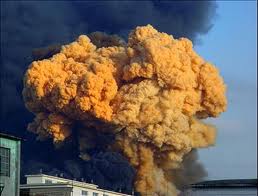
  • industrial pollution Nitrous Oxides: These are reactive greenhouse gases that stem from carbon based fuel combustion, and are one of the primary contributors to the formation of acid rain. NO2 creates highly acidic areas, which kills off plant and animal life.
  • Particulate Matter: this is one of the more significant human health hazards, because it penetrates lung tissue and can consequently lead to cancerous agents in the lungs, or possibly even Tuberculosis.
  • Volatile Organic Compounds: If you have been following the Ecolink blogs, then you have probably seen VOCs mentioned more than once. This is a term that refers to the volatility of organic compounds from manufacturing operations and processes that escape into the air in a gaseous state. VOCs create both hazardous indoor and outdoor toxins.

Several other types of industrial pollutants exist, but the ones listed above are the most abundant. Fortunately, industrial businesses have companies like Ecolink at their disposal, which researches, defines, and makes available the names of harmful industrial pollutions, and the reasons why these pollutants need to be eliminated. Ecolink also provides ideas and methods for transitioning to eco friendly, green alternative chemical solutions – from which all industrial companies can benefit, saving time, energy, money and the environment.

Search here

Don’t forget to share this post!

Categories

Suggested Blog Posts

View all News
By Khatera Barati
Khatera Barati - Digital Marketing Content Intern
Jul 07 2026

From WordPress to SEO: My Ecolink Marketing Internship

Reflecting on My Marketing Internship at Ecolink As my internship with Ecolink comes to an end, I’ve had the opportunity to reflect on how much I’ve learned over the...
By Mark
What Is an Epoxy Paint Stripper and What Are Its Uses?
Jun 29 2026

What Is an Epoxy Paint Stripper and What Are Its Uses?

An epoxy paint stripper is a heavy-duty chemical solution used to soften, swell, and remove cured epoxy paint from surfaces where standard paint removers are...
By Mark
How Boiler Water Treatment Chemicals Prevent System Corrosion
Jun 25 2026

How Boiler Water Treatment Chemicals Prevent System Corrosion

Boiler water treatment chemicals prevent system corrosion by controlling the conditions that allow metal attack: dissolved oxygen, carbon dioxide, low pH, hardness...
By Mark
Types of Water Treatment Chemicals
Jun 22 2026

Types of Water Treatment Chemicals

Choosing the right water treatment chemicals starts with knowing what the water contains, what the system needs to protect, and what regulations apply. The main types...
By Mark
Industrial Lubricants: Types, Uses, and How They Work
Jun 19 2026

Industrial Lubricants: Types, Uses, and How They Work

Industrial lubricants reduce friction, control heat, protect parts, and help industrial machinery run reliably under demanding operating conditions. If you need to...
By Mark
Industrial Degreaser: How to Keep Machinery Clean and Performing Efficiently
Jun 15 2026

Industrial Degreaser: How to Keep Machinery Clean and Performing Efficiently

Contaminated machinery runs hotter, wears faster, wastes energy, and fails sooner. The right industrial degreaser removes grease, oil, grime, carbon deposits, and...
By Mark
How Do Water-Based Cleaners Remove Grease from Industrial Metal Parts Safely
Jun 12 2026

How Do Water-Based Cleaners Remove Grease from Industrial Metal Parts Safely

Water-based cleaners remove grease from industrial metal parts safely by using surfactants, pH builders, emulsifiers, corrosion inhibitors, heat, and agitation to...
By Tomas Fernandez
Image of Latin America Region "LATAM Chemical Trends 2026"
Apr 16 2026

Latin America Chemical Trends 2026

A Strait 29 Nautical Miles Wide Is Reshaping Chemical Supply Chains Across Latin America. Here's What You Need to Know The Strait of Hormuz doesn't appear on most...
By Sydney Manns
Find HPLC-Grade Acetonitrile with Ecolink today! Availbale in 4x1, 5 gallon and 55 gallon options!
Mar 20 2026

Benefits of Acetonitrile HPLC Grade for Your Laboratory Needs

HPLC-grade Acetonitrile is one of the most widely used high-purity solvents in analytical chemistry, pharmaceuticals, environmental testing, and food safety.  Its...
By Khatera Barati
Acetone VS Paint Thinner for Cleaning, purchase from Ecolink today!
Jan 13 2026

Acetone vs. Paint Thinner for Cleaning: Which One Works Better and Why?

Acetone vs Paint Thinner for Cleaning  If you’re looking to purchase chemicals for your industrial cleaning application, it’s important to educate yourself on each...
View all News