
Understanding Cleaning Solvents: What is a Volatile Solvent & are there Other Options?
By technical definition, volatile solvents are substances that demonstrate a high degree of volatility in one or more contexts for one or more reasons. A volatile solvent can be classified in several ways, including: the agent in its formulation that causes volatility, whether the agent is manmade or organic, and the potential problems that the volatility is known to cause.
In this entry, we look at a particular class of volatile solvents, volatile organic compounds (VOCs), defining what they are and discussing what can be done to limit the negative repercussions of their volatility to help protect human health, particularly in industrial work settings, where an unusually high volume of volatile solvent is used in a given period of time.
What Are Volatile Organic Compounds?
Volatile organic compounds — a term that is typically shortened to the initialism “VOC” — are organic chemicals that have a high evaporation rate at room temperature. For example, the VOC formaldehyde, which is frequently found in commercial paint, has a boiling point of –2 °F. This means that the chemical will rapidly evaporate when the paint can is opened or the paint is sprayed onto a surface using mechanical pressurization equipment or an aerosol solution.
Concerning their origin, VOCs can be separated into two broad classes: biologically generated (i.e., naturally occurring) and anthropogenic (i.e., made by humans). Both classes of VOCs are widely used in industrial work processes, from painting, to degreasing, to the application of protective coatings. Examples of VOCs that are commonly used in industrial settings — or were commonly used before the Environmental Protection Agency (EPA) regulated their use — are:
- Benzene
- Chlorofluorocarbons
- Chlorocarbons
- Methylene chloride
- Perchloroethylene
- MTBE
- Formaldehyde
Not all VOCs are as harmful to human health as others. For example, chronic exposure to benzene is strongly associated with cancer, whereas the biologically generated VOC myrcene has no such connection. However, when a VOC is harmful to human health but must nonetheless be used in industrial processes, the company or organization should implement a set of strict safety measures to protect workers from inhaling vapor from the substance.
Protecting Against Toxic VOC Exposure
Unlike exposure to destructive agents such as hydrochloric acid, which can cause immediate, permanent injury, persistent injuries from exposure to toxic VOCs often occur gradually — and the primary method of exposure that causes the injuries is well known: inhalation. Consequently, any work environment where a dangerous, volatile solvent is used should feature the following protective measures to help prevent workers from receiving health threatening injuries.
- Ventilation system for filtering airborne contaminants
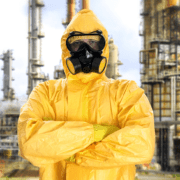
- Personal protective equipment suitable for the level of exposure
- Applying solvent in airtight cleaning systems if possible
- Airtight solvent waste trap for preventing emissions
VOCs are sometimes misconstrued to be safe due to their organic nature, but this isn’t always the case. That is why it’s important to work with an experienced provider of industrial solvent solutions before you order a volatile solvent. If you need assistance selecting an industrial solvent for a specific cleaning operation or general cleaning, contact the solvent specialists at Ecolink today by calling (800) 563-1305, or refer to the contact page on our website.