
Q
  1. Home
  2. Water Treatment Chemicals
  3. What is Deionized Water?

What is Deionized Water?

Deionized water, also known as DI water or demineralized water, simply means water that has had ions removed. Ions are electrically charged molecules found in sunlight, radiation, air, and water. They either have a net positive or net negative charge: ions with a positive charge are “cations” and negatively charged ions are “anions.”

deionized water

For industrial, chemical, and other applications in which water is used as a rinsing agent, these ions are considered impurities and need to be removed from the water for accurate work. Some common ions found in water include: 

  • Calcium (Ca++) 
  • Iron (Fe+++) 
  • Sodium (Na+) 
  • Hydrogen (H+) 
  • Chlorides (Cl-) 
  • Hydroxyl (OH-) 
  • Sulfates (SO4–) 
  • Nitrates (NO3-) 

How is Deionized Water Made? 

DI water is made by running any type of water (tap, distilled, spring, etc.) through a resin that is electrically charged; both positive and negative ions are in this resin. Sometimes, two electrically charged resins may be used–one resin will remove the negatively charged ions, and one will remove the positively charged ions. The cation resin, or the one containing positively charged ions, is usually first in line.  

When the starting water is rinsed through the resin(s), the cations and anions exchange with hydrogen (H+) and hydroxyl (OH-) in the resin, which in turn produces H2O or water. This process results in demineralized water, which is reactive, meaning that the properties of the water begin to alter as soon as it is exposed to air. Normal water has a pH of about 7, which is neutral on the pH scale. DI water also has a pH of 7 after initial production, but the carbon dioxide in air incites a reaction that produces hydrogen and bicarbonate (HCO3-), lowering the pH to about 5.6, which is more acidic than normal water.  

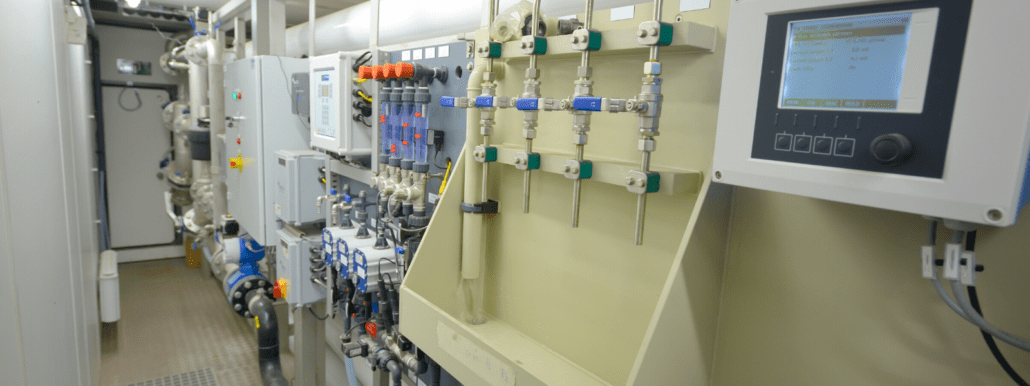
Demineralized water is made in something called a DI water system. This system is an arrangement of water tanks (and other components) that are used to purify water. A DI system can be a single tank or a set of multiple tanks and may be used for other water purification methods such as UV disinfection or reverse osmosis. Each tank in these systems contains the electrically charged resin used to remove ions from water. Tanks may be larger or smaller in size, depending on the quantity of water that will be processed through them.  

What is Deionized Water Used For? 

Usually, DI water is used in chemical laboratory settings where the water needs to be 100% pure. Higher water purity means more predictable, accurate results that can be repeated multiple times. This is also useful in pharmaceutical settings.  

Aside from this, demineralized water has several household applications. This includes: 

  • humidifiers 
  • household appliances that produce steam 
  • aquariums 
  • automotive car 
  • cleaning products 
  • hygiene products 
  • fragrances 

Need to Make Some Deionized Water? 

Look no further! Contact the Ecolink team with any questions you may have. We provide a whole product category of water treatment chemicals to find the one that best fits your needs!

Search here

Don’t forget to share this post!

Categories

Suggested Blog Posts

View all News
By Tomas Fernandez
Image of Latin America Region "LATAM Chemical Trends 2026"
Apr 16 2026

Latin America Chemical Trends 2026

A Strait 29 Nautical Miles Wide Is Reshaping Chemical Supply Chains Across Latin America. Here's What You Need to Know The Strait of Hormuz doesn't appear on most...
By Sydney Manns
Find HPLC-Grade Acetonitrile with Ecolink today! Availbale in 4x1, 5 gallon and 55 gallon options!
Mar 20 2026

Benefits of Acetonitrile HPLC Grade for Your Laboratory Needs

HPLC-grade Acetonitrile is one of the most widely used high-purity solvents in analytical chemistry, pharmaceuticals, environmental testing, and food safety.  Its...
By Ecolink Team
Acetone VS Paint Thinner for Cleaning, purchase from Ecolink today!
Jan 13 2026

Acetone vs. Paint Thinner for Cleaning: Which One Works Better and Why?

Acetone vs Paint Thinner for Cleaning  If you’re looking to purchase chemicals for your industrial cleaning application, it’s important to educate yourself on each...
By Ecolink Team
Where to Buy Denatured Alcohol Near Me
Dec 29 2025

Where to Buy Denatured Alcohol Near Me

Denatured alcohol can be purchased through local hardware retailers for small-scale use or via industrial chemical suppliers for high-volume manufacturing and...
By Ecolink Team
Dielectric Spray Guide: Featuring Ecolink’s 22oz Trigger Solution
Dec 17 2025

Dielectric Spray Guide: Featuring Ecolink’s 22oz Trigger Solution

Dielectric Spray Guide: Featuring Ecolink’s 22oz Trigger Solution  Dielectric sprays are essential for keeping delicate electrical components from moisture, corrosion,...
By Ecolink Team
Where to Purchase Isopar M for Sale Online: Ecolink’s Advantage
Dec 01 2025

Where to Purchase Isopar M for Sale Online: Ecolink’s Advantage

Where to Purchase Isopar M for Sale Online: Ecolink’s Advantage  When it comes to finding and sourcing industrial solvents such as Isopar M, you need a reliable and...
By Ecolink Team
What is Isopar M Used For? - Purchase Isopar M
Nov 26 2025

What is Isopar M and what is it used for? Applications & Advantages

Isopar M is a highly pure, odorless isoparaffinic solvent used in a range of industries.  Why?   Because of its low toxicity, clean evaporation, and consistency, it...
By Ecolink Team
What is Isopar L User For?
Nov 17 2025

What is Isopar L Used For?

Looking for insight into Isopar L? You’ve come to the right place.  In this blog post, we’re going to take a closer look at what Isopar L is, what it’s used for, and...
By Ecolink Team
Hydrofluoroether Solvent
Nov 03 2025

Hydrofluoroether Solvent Guide

With all the industrial solvents available on the market, it can be overwhelming to find one that works well and has a low toxicity.   Luckily, hydrofluoroether (HFE)...
By Ecolink Team
White Oil - Ecolink
Oct 27 2025

White Oil in Food Packaging Applications: What You Need to Know

White oil is an extremely versatile oil with many benefits—especially for the food manufacturing industry.  But what is it? And what makes this oil so special for...
View all News