


Wood Alcohol (Methanol): Everything You Need to Know
Updated: December 4, 2025
Wood alcohol, also known as methanol or CH?OH, has many purposes.
But what exactly is methanol? And is it right for your business application?
In this blog, we’ll discuss the properties and various industrial uses of this alcohol, its origins, how it’s made, and more.
Already know that methanol is right for your business’ industrial application? Click here to start shopping for Ecolink’s methanol!
What Is Wood Alcohol?
Wood alcohol is another name for methanol (CH?OH), a simple alcohol historically produced by heating wood in the absence of oxygen through a process known as destructive distillation.
Today, methanol is mainly made from natural gas or biomass through gasification and catalytic synthesis, and is commonly used as an industrial solvent, fuel, and chemical feedstock.
It’s important to note that CH?OH is highly toxic and is never safe for drinking, unlike some grain alcohols.
Let’s look at some basic properties of CH?OH:
- Colorless liquid
- The boiling point of 64.96 C or 148.93 F
- Solidifying point of -93.9 C or -137 F
- Explosive in air
- Burns with a nonluminous flame
- Forms homogeneous mixtures with water
- Odor like ethyl alcohol
- Intoxicants of alcoholic beverages
- Strong poison
- High-octane, clean-burning fuel source
Methanol has become a valuable substance in various industries due to these properties.
Need to purchase methanol in bulk for your business? Click here to view Ecolink’s cost-effective bulk ordering options!
History & Origins
The distillation of wood to create CH?OH dates all the way back to the Ancient Egyptians, who used this chemical in their embalming process.
However, the first isolate pure methanol wasn’t produced until the 1600s when the chemist, Rober Boyle distilled it from boxwood, deeming it the “spirit of box.” And by the 1800s, chemists had determined wood alcohol’s elemental composition, calling it “methylene,” but the name was later changed to what we now know as: methanol.
Nowadays, methanol is used in the U.S. and across the world as a chemical in key industrial processes.
How Is Wood Alcohol Made?
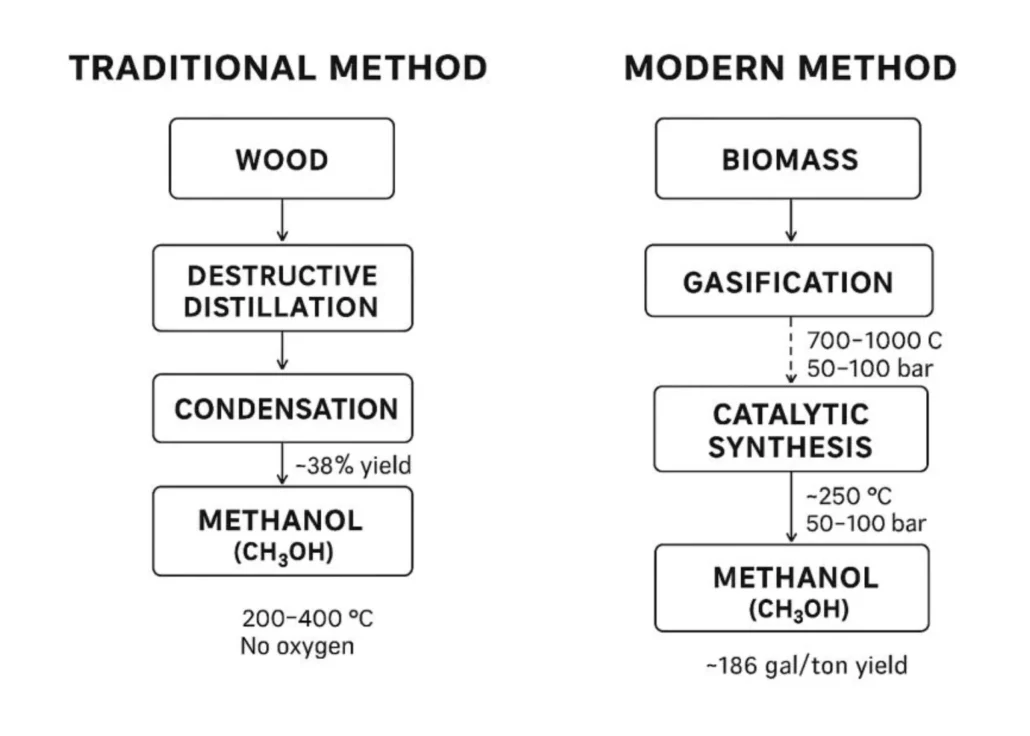
When it comes to producing this alcohol, there are a couple different methods: Destructive Distillation and Biomass Gasification.
Let’s take a closer look at these two processes.
Traditional Method: Destructive Distillation of Wood
This method is considered the most traditional way to produce CH?OH. In this process, wood is chopped and dried before it’s sealed into a furnace or retort where it’s heated without oxygen.
- Heating: Once the wood reaches 200-400 degrees C, thermal decomposition occurs, breaking the wood down into charcoal, gases, and pyroligneous acid.
- Condensation: The vapors from the heated wood are cooled and condensed into a liquid mixture containing methanol, acetic acid, and other compounds.
- Distillation: This mixture is then distilled, separating the methanol from the rest of the components.
Modern Industrial Method: Biomass Gasification + Catalytic Synthesis
The modern method of Biomass gasification is more popular than destructive distillation due to its renewable qualities. Here’s how it works.
- Gasification: Biomass (e.g., wood chips, agricultural waste, etc.) is heated at 700-1000 degrees C under controlled oxygen to produce syngas (a mix of CO, H2, and CO2)
- Gas Cleanup: Impurities, such as tar, are then removed to protect the catalysts.
- Catalytic Synthesis: The syngas is passed over a catalyst (usually copper-zinc-alumina) at 50-100 bar pressure and moderate temperature to form methanol
- Purification: Finally, methanol is condensed and purified.
BONUS: This modern process also yields a higher result of methanol than traditional distillation.
Click here to explore Ecolink’s industrial-grade methanol products.
Applications & Uses
When it comes to applications, it’s common to find this type of alcohol being used in industries such as:
- Automotive
- Cosmetics
- Agricultural
- Building
- Fuel
The automotive industry commonly uses methanol to create antifreeze and windshield wiper fluid. This alcohol can also be used as a general solvent; however, it is often used as an additive in paint thinners. Its use in the cosmetic industry is a perfume additive.
The agricultural industry uses it to produce pesticides since this alcohol is an essential ingredient in formaldehyde. Formaldehyde is also crucial in the building industry since it is used in glues as well as wooden building materials
Lastly, methanol has become a detrimental compound in the fuel industry. This alcohol is a high-octane yet clean-burning fuel source. It can be found in rocket fuels and various other fuels. There have been recent advancements in replacing gasoline in automotive vehicles with methanol.
Safety & Hazards
This alcohol is a highly poisonous compound if it is ingested. It is known to cause blindness and can even lead to death.
Some symptoms of methanol poisoning include:
- Difficulties breathing
- Blurred vision or blindness
- Low blood pressure
- Confusion, dizziness, or coma
- Nausea and vomiting
- Severe abdominal pain
If you experience any of the above symptoms when handling wood alcohol, immediately contact your local poison control center and seek medical attention.
To prevent any negative health consequences when handling this chemical, be sure to follow all safety handling guidelines outlined on the SDS of the product.
For more information about exposure limits, visit the OSHA Occupational Chemical Database.
Shop Ecolink’s Bulk Wood Alcohol Solutions
At Ecolink Inc., we’re here to help your business find the best chemical solution for your industrial application.
Check out our best-selling Methanol, available to purchase in bulk, with availability in 5-gallon or 55-gallon pails!
For assistance in finding cleaning solutions that offer an effective and safer cleaner than traditional solutions, contact our expert chemists today for more information.
FAQs
Q: Is wood alcohol the same as rubbing alcohol?
A: No, the two are not the same. Wood alcohol is methanol, which is highly toxic. Rubbing alcohol, on the other hand, is ethanol-based and safer to use, making it a common ingredient in industrial and household cleaning solutions.
Q: Why is wood alcohol toxic?
A: Methanol metabolizes into formaldehyde and formic acid in the body, which can cause blindness or death even in small amounts.
Q: Can it be used as fuel?
A: Yes, methanol is used in fuel blends, racing fuels, and can even be used as a feedstock for biodiesel.
Q: How is it different from ethanol?
A: Methanol (wood alcohol) is highly poisonous, while ethanol (grain alcohol) is safe for consumption in some beverages.
Q: What safety gear is required?
A: At Ecolink Inc., we recommend using chemical-resistant gloves, goggles, and proper ventilation. Always consult the Safety Data Sheet (SDS) for correct handling guidelines for each product.
 Ecolink Intern

 Ecolink Team


