Ecolink, Inc.
Q
  1. Home
  2. Industrial Degreasers
  3. The Process of Liquid-Liquid Extraction

The Process of Liquid-Liquid Extraction

Last updated:

What is Liquid-Liquid Extraction?

Liquid-Liquid extraction is a more complex process of separating a liquid mixture over the Liquid-Solid process. Another common term for Liquid-Liquid extraction is as solvent extraction process. The process involves taking liquids, mixing them, and being able to separate them when the liquid settles. Often one part is water while the other can be an organic solvent. The process is illustrated below:
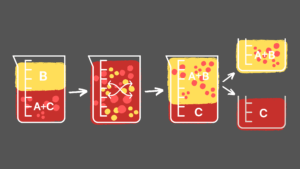
THE EXTRACTION PROCESS

The process involves having an immiscible mixture, represented by A+C and B the parts can be transferred and mixed, and separated. It extracts a solute from a two-part solution by being brought together with another non-homogenous solvent where that solute can be dissolved. From this, the liquid mixtures are isolated with the solutes that can be dissolved distribute where necessary.

Solvents Used in Liquid-Liquid Extraction

While in a Liquid-Solid extraction water is the most common solvent used, in Liquid-Liquid extraction Diethyl Ether is most commonly used. Since the process for Liquid-Liquid extraction requires immiscible solvents things like ethanol and acetone should not be used because they mix with water. Therefore, the listed solvents below are recommended for Liquid-Liquid extraction:

  • Hexane
  • Diethyl Ether
  • Dichloromethane
  • Toluene

All are more commonly chosen for the organic solvent used in this extraction process.

Liquid-Liquid Extraction Uses

There are several processes that require Liquid-Liquid extraction and here are some of the most common uses below:

  • Fermentation
  • Pharmaceuticals
  • Fragrances
  • Food Products
  • Agriculture Chemicals

You can refer to our blog about Liquid-Solid extraction to examine that these two types of extraction methods are used in repetitive industries. So, in a way, they go together at times in terms of their common uses and processes within these industries.

Solvent extraction or Liquid-Liquid extraction is a process that relies heavily on the use of proper solvents. If you have more questions or need more information on the solvents for extractions, we have answers contact us here at Ecolink!

Search here

Don’t forget to share this post!

Categories

Suggested Blog Posts

View all News
By Mark
Common Causes of Foaming in Industrial Water and Effective Control Methods
Jul 17 2026

Common Causes of Foaming in Industrial Water and Effective Control Methods

Excessive foam in industrial water systems disrupts operations, reduces treatment efficiency, causes overflow events, and creates worker safety hazards that cost...
By Mark
Key Benefits of Using an Aerosol Degreaser for Electronics
Jul 13 2026

Key Benefits of Using an Aerosol Degreaser for Electronics

Grease, flux residue, dust, and moisture accumulation on circuit boards and electrical contacts are among the leading causes of premature equipment failure in...
By Mark
What Is a Flux Remover: Benefits, Usage, and Appropriate Selection Guide
Jul 10 2026

What Is a Flux Remover: Benefits, Usage, and Appropriate Selection Guide

Flux residues left on printed circuit boards after soldering are one of the leading causes of premature electrical failures in electronics manufacturing. These...
By Mark
How Do Water-Based Cleaners Remove Grease from Industrial Metal Parts Safely
Jul 10 2026

How Do Water-Based Cleaners Remove Grease from Industrial Metal Parts Safely

Water-based cleaners remove grease from industrial metal parts safely by using surfactants, pH builders, emulsifiers, corrosion inhibitors, heat, and agitation to...
By Khatera Barati
Khatera Barati - Digital Marketing Content Intern
Jul 07 2026

From WordPress to SEO: My Ecolink Marketing Internship

Reflecting on My Marketing Internship at Ecolink As my internship with Ecolink comes to an end, I’ve had the opportunity to reflect on how much I’ve learned over the...
By Mark
Why Industrial Lubricants Are the Backbone of Modern Machinery
Jul 06 2026

Why Industrial Lubricants Are the Backbone of Modern Machinery

Improper lubrication causes 64% of bearing failures, making it the single greatest preventable cause of machinery breakdown across every industrial sector. That...
By Mark
What Is an Epoxy Paint Stripper and What Are Its Uses?
Jun 29 2026

What Is an Epoxy Paint Stripper and What Are Its Uses?

An epoxy paint stripper is a heavy-duty chemical solution used to soften, swell, and remove cured epoxy paint from surfaces where standard paint removers are...
By Mark
How Boiler Water Treatment Chemicals Prevent System Corrosion
Jun 25 2026

How Boiler Water Treatment Chemicals Prevent System Corrosion

Boiler water treatment chemicals prevent system corrosion by controlling the conditions that allow metal attack: dissolved oxygen, carbon dioxide, low pH, hardness...
By Mark
Types of Water Treatment Chemicals
Jun 22 2026

Types of Water Treatment Chemicals

Choosing the right water treatment chemicals starts with knowing what the water contains, what the system needs to protect, and what regulations apply. The main types...
By Mark
Industrial Lubricants: Types, Uses, and How They Work
Jun 19 2026

Industrial Lubricants: Types, Uses, and How They Work

Industrial lubricants reduce friction, control heat, protect parts, and help industrial machinery run reliably under demanding operating conditions. If you need to...
View all News